Monday, July 8, 2019

In Defense of Twilight

Like many of my friends growing up, I was a Twilight hater. I was a firm believer that the books and movies were equally terrible, problematic, and simply not worth my time. However, several years later, my godmother forced me to watch all five Twilight movies in three days, insisting that I was blind to the ways in which the movies were just plain fun, and actually had something interesting to say. And now I have to admit, she was right. Not only has Twilight become a guilty pleasure movie that I have seen countless times, but I have given a fair bit of thought to how I could analyze the film in a new light. So here I am, on my horror blog, writing in defense of Twilight.

The first question I asked myself was: what role, if any, does Twilight play in the genre of horror? And while Twilight itself is not strictly speaking a horror film, what horror elements does it include, and what impact has it had (for better or worse) on the horror/vampire genre as it exists today? Well, the vampire itself is inherently an element of horror. As a monster that arose in its present form from Gothic Horror literature titles such as The Vampyre, Carmilla, and Dracula, the vampire has been a staple antagonist in horror film for decades. Classically, the character of the vampire has been used to explore the thematic relationships between sex, death, and violence. The vampire as a monster is an essentially sexual one. Vampires are often used as a catalyst for authors and filmmakers to explore ‘sexual taboos’, such as homosexuality/homo-eroticism in a text like Anne Rice’s Interview with the Vampire, or female sexuality in a character like Lucy in Bram Stoker’s Dracula. To return to Twilight, I find it interesting to think about what similar themes the archetype of the vampire could be being used to explore, especially when keeping in mind the variety of sexually conservative themes brought in by Stephanie Meyer’s background. For the most part, I see these themes represented best in the character of Bella.
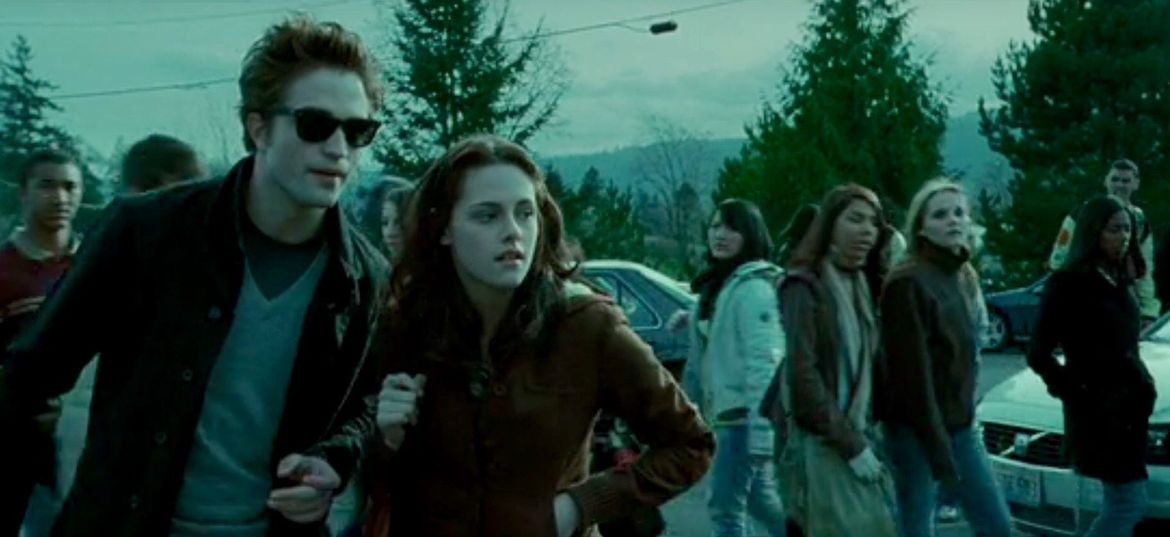

I’ll probably lose film critic cred for this but I must say...I mostly like Bella Swan as a character. No doubt that she has a lot of faults, but in many ways she is an extremely relatable depiction of a teenage girl with a crush. Her life-or-death relationship with Edward may seem dramatic, but honestly, most of the books’ readership was young girls whose feelings at that time probably felt very similar. However, my favorite thing about Bella in the context of sexuality, is that she is the main initiator of her physical relationship with Edward. Twilight flips the script on the classic pure heroine being seduced by the vampire. Instead, it is Bella who is trying to seduce Edward. She spends most of the books more or less sexually frustrated because her century-year-old vampire boyfriend wants to wait until marriage. I find this not only extremely entertaining, but also a pretty interesting inversion of such a standard vampire film troupe.

To return to what horror elements can be seen in the film, I see a number of common horror themes and tropes reflected in the series. And to be perfectly honest, several of the early Twilight films have actually scary moments. In the first film, the scene were the vampire James attacks Bella in her childhood dance studio is genuinely frightening. James is brutal, sadistic, and ruthless in a way very few other vampires in the Twilight universe are. The violence of the vampires is exemplified again in the new-born vampire army’s feeding frenzy in Eclipse. Additionally, the sequence where Bella is cornered by a group of men seemingly intending to sexually assault her as she walks alone at night is more than a little sickening. I chalk most of the fear factor in such seems up to Catherine Hardwicke’s stylized direction (I honestly would love to see her make a horror movie), but there is no denying that there are many elements of Twilight that carry on the legacy of vampire horror flicks past. Not to mention that the film’s set up is straight up horror. ‘Lonely girl moves to a small town with a secret family of immortal monsters’ seems like a movie that could have gone in a very different direction.

To wrap up, I’ll just say it. I love Twilight. What started out as a guilty pleasure watch has transformed into one of my favorite movies of all time. And of course, there are things to critique about these films. The unhealthy co-dependency of Edward and Bella or the anti-abortion undertones of the fourth film are perfectly valid aspects of this series to critique, and I could write another whole essay about them. However, today I wanted to write in defense of Twilight, because I see more than a couple good reasons that this series became the phenomenon that it did. It remains to this day, the highest grossing movie ever directed by a woman, and an integral part of the history of vampire cinema. So the next time you hear someone bashing Twilight, send them my way.


Wednesday, May 1, 2019

A Postmodern Deconstruction of Scream

Hello wonderful followers! I am currently in a Principles of Literary Criticism class at my university, and wanted to share one of my assignments with you! In the imaginary dialogue you’re about to read, prominent literary theorists and philosophers, Judith Butler and Jacques Derrida, will discuss the deconstuctive powers of Scream. Their conversation centers around the concept of the Final Girl, something that is clearly close to my heart. I encourage anyone who loves this movie as much as I do to check it out! Thank you!

Joe Bob, Madman, & The 80s Slasher

This past Christmas, I happened to see an episode of Joe Bob Briggs’ The Last Drive-In on Shudder. And what a gift that turned out to be! Since his new weekly series premiered a couple months ago, I have been watching his double features almost every week. Showing everything from Q to Deathgasm, Joe Bob is most definitely one of the most charismatic hosts on television...ever. Not only does he seem to remember practically every fun-fact in existence about the movies he selects, but his opening monologue and mid movie tangents always leave me laughing, or cringing, or downright impressed.

However, while Joe Bob may be new to me, I have come to learn that he is definitely not new to the horror community at large. Starting out as a movie reviewer for a number of Texas newspapers, Joe Bob would move on to hosting a variety of film-centric TV shows, most notably TNT’s MonsterVision from 1996-2000, where his double feature format was first established. Complete with mail girls and drive-in totals, MonsterVision was the show that first really hooked horror fans on Joe Bob. In the summer of 2018, Shudder revived Joe Bob’s show, under the moniker of The Last Drive-In, when he hosted a 26 hour marathon of his favorite horror flicks. After two more successful marathons on Thanksgiving and Christmas, in March 2019 Joe Bob’s show became a weekly Shudder staple, where viewers could watch the series live every Friday night.


Last weekend, the first movie on The Last Drive-In was Joe Giannone’s 1982 slasher, Madman. Staring Gaylen Ross of Dawn of the Dead as the quazi-Final Girl, Madman tells the story of  Madman Marz, a killer who stalks the woods of a camp for gifted children, killing anyone who speaks his name above a whisper. However, Madman does not seem to adhere to classic slasher trope. This is partially because the slasher as we know it today did not yet exist in 1982, but it still feels worth mentioning. The reason why I refer to Betsy (Ross) as a “quasi-Final Girl” is that...she isn’t. Not only does Betsy break the Final Girl rules (she’s blonde, sexually active, and well, dies), but she is also survived by two other characters in the film, Max and Richie.

Honestly, it's pretty amazing Richie was allowed to survive at all. Not only was he the one to summon the Madman in the first place, but he spends the entirety of the film wandering around the woods until coming across the house where Marz killed his family. Richie even makes an accidental trip into Marz’ body dump/torture basement, and lives to tell the tale. He makes it back to the main road, encounter’s Max, and declares in a hilarious close up shot of his eyes, “Madman Marz...he’s real!” I really couldn’t tell you whether this was actually a subversive plot point, or simply lazy film-making.

Aside from a pretty unbearably cringy hot tub scene and extremely questionable decisions made by practically every character, I was pleasantly surprised how well this film held up in 2019. It was fun, funny, and had a number of creative kills. Of course, it was greatly improved by Joe Bob’s frequent intermissions and the truly staggering number of fun facts he delivers. But I’m going to have to agree with Joe Bob on this one...Grace says, check it out!

The Wendigo in Pet Sematary (2019) (4/8/19)

I having a sneaking suspicion that after watching Pet Sematary, the question on a lot of peoples’ minds was “what is a Wendigo??”, along with “why was it so briefly referenced in the movie, with no clear relevance??”. Well… let's find out. First, before we can understand what importance a symbol like the Wendigo could have in PET SEMATARY, we must first understand exactly what a Wendigo is. In Native American Algonquian folklore, the Wendigo is a mythical beast with an insatiable taste for human flesh. The Wendigo often appears as a lanky, gaunt being with massive antlers, and is traditionally associated with greed, starvation, cannibalism, and murder. Conceptually, however, the Wendigo can be seen as a monstrocized version of a human consumed by selfish greed, especially one who lacks the foresight to see that devastating consequences of their self-serving actions. That greed is symbolically represented in the Wendigo’s constant hunger to consume the flesh of men.

The Creature in the Woods: The Role of the Wendigo in Stephen ...

In the context of PET SEMATARY,  it is the mythical power of the forest-dwelling Wendigo that imbues the burial ground with its powers of resurrections. The Wendigo itself is only physically shown twice, initially in Jud’s book and again for a moment in the forest, but the concepts it represents heavily permeate the film. Not only does the burial ground itself quite literally want to consume the flesh of the beings that are buried there, but when those beings are resurrected, they become possessed with the desires of the Wendigo, to kill and to claim the bodies of those around them for their own. When Ellie returns from the grave, she appears to have lost her humanity, her soul if you will. She is driven purely by a brutal, animalistic desire to slaughter her family, and have them join her in living death. The Wendigo pulls the string throughout the entirety of the film, leuring Louis into the woods, and recalling Rachel’s repressed memories of her sister Zelda’s death.

However, more so than the ways in which the Wendigo is represented in the “monsters” of PET SEMATARY, I am fascinated by the ways  Louis’ character embodies some of these concepts. One of the ideas that the Wendigo is most closely associated with in folklore is selfishness. Similarly to the Freudian concept of the Id, the Wendigo can bring out the most base and self-serving desires in its victims, namely Louis. While the bond between a parent and a child is commonly thought to be the most selfless human relationship, by bringing Ellie back from the grave, Louis is in no way acting in her best interest. Just as in Mary Shelley’s Frankenstein, Louis ultimately holds responsibility for the life and actions of the being he creates. And yet, while we know Louis is wrong to resurrect Ellie, it is hard to imaging making any other choice after the death of one’s own child. I realize I am getting off the topic of the Wendigo to a certain degree, but at the same time, it is humanity’s inherent selfishness that the Wendigo can be seen to represent. PET SEMATARY is so especially crushing because the audience must watch Louis bring doom upon his family, while knowing we would probably make the exact same choice.

**This analysis is meant to be applied to the 2019 film adaption, independent of the King novel.

Jordan Peele’s Us, The Twilight Zone, and the Doppelganger (4/26/19)

As much as I enjoyed watching Us, the first thing I said after the film ended was, “well what am I supposed to do with that!”. Beautiful cinematography and endlessly creative concept aside, I must say that I was (and still am), a bit confused as to what Us was trying to tell me, particularly with the plot twist at the very end of the film. I saw the film with my family, and in reference to the twist, my father described the movie as a episode of The Twilight Zone, which I found slightly ironic, given that Peele is heading its upcoming reimagining.

However, a comparison to The Twilight Zone seems especially fitting. At least in my experience, The Twilight Zone tends to target human fears that are more internal than external, contrary to the majority of horror. Mainstream horror as a genre tends to play on fears of outside forces, such as serial killers, monsters, supernatural entities, violence, pain, etc. However, in shows like The Twilight Zone, the horror is often much more psychological, twisting the viewers expectations, commenting on human nature and behavior, as well as playing largely on our fear of reality defying reason. As a kid, The Twilight Zone used to freak me out like nothing else could, that eerie theme song triggering a kind of Pavlovian unease in my 10 year-old self.

Us' Reflects a Mirror Image of 'The Twilight Zone' - The New York ...

To return to Us, the most obvious interpretation of it is, of course, our fear of ourselves. Fear of the ‘shadow self’, the ‘dark side’. A fairly common trope, the double or doppelganger is a innate creepy concept. Historically in literature, doppelgangers often represent the ‘evil twin’ of the character they double, and are often used symbolically harbingers of bad luck. Directly translating from German as “double walker”, in a number of Scandinavian mythologies, they serve as physical manifestations of fate. In Norse mythology the double performs a person’s actions in advance, referred to as a ‘firstcomer’, or is alternatively a personification of death. Applying this historical significance of the doppelganger to Us provides some interesting insight.

The connection between the tethered humans on earth and in the compound closely reflects this concept of the ‘firstcomer’. Adelaide’s double explains how the tethered were created as a way to control the people up above, perhaps by performing their actions before they do, removing their free will. However, the experiment failed, leaving the shadows to carry out the actions of their earthly double, often in twisted and obscene ways. Therefore, the doubles in Us can be interpreted in a number of ways. We can see the shadow as a representation of the dark side taking over, as a commentary on our lack of true free will, or simply as a harbinger of some inevitable doom to befall the human race.