Thursday, February 27, 2020

Amy Elliott Dunne: The Greatest Female Villain of All Time

When I first watched the film GONE GIRL (dir. David Fincher), I was unconvinced. Gillian Flynn’s book was so close to my heart, and no movie adaptation could possibly have satisfied me. I found Ben Affleck as Nick too sympathetic, whereas in the book I was nearly rooting for Amy’s victory. However, having just re-watched the film, I can honestly say that it is nearly perfect. Rosamund Pike’s performance as Amazing Amy chills me to my core, and as true as her infamous ‘Cool Girl’ monologue may be, the loss of her “person suit” in the third act makes her the most captivating on-screen psychopath since Hannibal Lecter.

Amy Elliott Dunne: My Favorite Monster | 25YL Film Analysis

Reminiscent of a more-controlled Glenn Close in FATAL ATTRACTION, Rosamund Pike effortlessly captures Amy Dunne’s masterful destructive power. Her flawless plan, her casual decision to take her own life in her quest for revenge, and her subsequent killing of Desi Collings, all paint a picture of a cold-blooded murderess with no capacity for remorse. Desi, however, is an interesting counterpoint to Amy. Yet his need to control and possess Amy is no match for her need for control over herself. Amy Elliott Dunne cannot be trapped; she refuses to be under circumstances that are not of her own making, which was the catalyst for her systematic destruction of her husband, Nick.

With the loss of her trust-fund, and after moving to Missouri to help care for Nick’s mother, for the first time in her life Amy was without agency. As the ‘Cool Girl’ facade Nick fell in love with began to fade, Amy realized she was losing control over him as well, with the realization of his infidelity. Using the skills she developed framing Tommy O'Hara for rape, she perfectly orchestrates Nick’s arrest and almost-conviction for her murder. Only after proving his own ability to manipulate, and deference to her authority, does Amy return to him.


In the novel I felt as if they deserved each other; they were two screwed up people and yet a match for each other. But the film creates even more of a sense of dread around Nick being trapped in a house with Amy at the film’s conclusion. I fear for his safety, and the safety of their child. A true feeling of horror washed over me seeing Nick cower in the corner of a dark room, clutching their cat close to his chest, as Amy sleeps peacefully in the next room. As far as horror in GONE GIRL goes, I would be remiss not to mention Desi’s death scene, one of the most graphic sex/murder scenes in cinematic history.

Seeing the blood pour over Amy’s face, and the exhilaration she feels watching Desi die, solidifies your assumption as a viewer that Amy is truly capable of anything. Not only does she lie, manipulate, frame, and reconstruct herself so easily, but she is a killer. While there is something empowering about Amy Elliott Dunne, despite her...problematic behavior, she honestly scares me. Almost a less sadistic, Americanized Asami from AUDITION, Amazing Amy has become a household name for a reason.

I’m sure some would argue with me over whether GONE GIRL could even qualify as a horror film, however, I would counter by saying that blurring the line between horror and thriller is what many Fincher films do best. SEVEN and ZODIAC both walk this same line. If Amy Elliott Dunne is not a straight-up horror character, then I don’t know what is. While I wish the film made me doubt Nick’s innocence as successfully as the novel, it encapsulates the spirit of Amy in all of her horrifying glory.

Thursday, January 23, 2020

Found Footage: The Blair Witch Project (1999) & Paranormal Activity (2007)

I must admit that my love of horror is rather new; not more than three years ago, I would have flat-out refused to watch the two films I will be discussing today. PARANORMAL ACTIVITY (dir. Oren Peli) and THE BLAIR WITCH PROJECT (dir. Eduardo Sánchez & Daniel Myrick) are two defining films in the genre known as “found footage.” This genre has a reputation of being particularly raw due to the realism of its cinematography and performances, making it particularly frightening to audiences willing to suspend their disbelief and buy into its reality. While found footage films have a long legacy before BLAIR WITCH, its 1999 viral release was one of the first times the genre gained public media attention, thus reviving its popularity. While I was not alive during the marketing of the BLAIR WITCH, I have a feeling that it had a lot to do with how the film was perceived. The actors played characters with their own names, whose faces were plastered on missing poster circulated along with the films trailers, touting the film as real “recovered footage” from the fictional film students.

I have long heard THE BLAIR WITCH PROJECT heralded as one of the scariest movies ever made, one that scares even the most seasoned of horror fans. However, I will have to disagree. While I can appreciate the craft and ingenuity of the film, I merely found it creepy, rather than on-the-edge-of-your-seat scary. I believe the film’s low budget, and goal not to actually show the titular witch, could have been maintained while giving the audience a little bit more to be afraid of. I found it much more interesting as a depiction of what happens to different personality types when they get lost in the woods, than as a supernatural horror movie. This was mostly due to the fact that the copious scenes of Heather, Mike, and Josh screaming at each other defused much of the scares the film was trying to create. I would have appreciated a simple blurry silhouette of the entity attacking them, and perhaps to catch a glimpse of what it was doing to Josh. I will definitely give credit to the audio mixing for being the scariest aspect of BLAIR WITCH by far, but the dark, blurry, forest shots at night did little for me.

I also felt that the climactic scene in the broken down house had a lot more potential than it was allowed. Screaming, dropped cameras, and one shot of Mike facing a wall was not quite enough for me as a viewer to comprehend the full horrific experience of the characters. At the end I literally yelled, “What, that’s it??” out loud. I wanted so badly to be scared by this film, and had such high expectations, that I was probably setting myself up for disappointment. The interactions between the characters, and how they behave while being terrorized, was definitely the most interesting aspect of this film, but I’m not sure they were even complex enough for me to want to analyze. However, I had a complete opposite reaction to PARANORMAL ACTIVITY.


I enjoyed PARANORMAL ACTIVITY so much, that I have already seen it twice in 2020. It actually freaked me out, forcing me to turn all the lights on in my house when I finished it, and jump at every strange noise. Delightful. I found this movie not only entertaining, but actually interesting to analyze on a deeper level. The way being haunted affects Katie and Micah’s initially too-adorable relationship feels realistic, and many of the decisions they make feel much more plausible than those in BLAIR WITCH (Mike threw the map in a RIVER!). The slow-burn way the frights build night after night creates a great amount of tension, leading to a very satisfying final payoff, horrifically foreshadowed by Katie’s demonically tinged voice saying, “I think we’ll be ok now.” PARANORMAL ACTIVITY creates a horrible feeling of being alone with a demonic entity, knowing that there is no one who can help or save you. And while the trope of the person being haunted, rather than the house, may be overdone, it is incredibly effective in this film, shot completely within the confines of an upper-middle class California home. It is the house’s normalcy that makes the film even more frightening, making the audience feel as if this could happen to them. The overnight camera footage is also extremely effective, since it shows us what could possibly be happening in our own homes, were they haunted, while we sleep.

Katie and Micah’s performances are very compelling, and their realism is the main driving factor behind how easy it was for me as a viewer to buy into this film being “found footage.” She is empathetic and her fear feels genuine, and he is equally endearing as he is frustrating. Their differing opinions on how the demonic threat should be addressed create conflict that feels very true to life, in terms of how couples bicker in more every-day scenarios. In terms of the scares, this film also utilizes very few special effects, and in my opinion, much more effectively that THE BLAIR WITCH PROJECT. Slamming doors and loud banging noises make the most frightening scares, and I would argue that the demon footprints and ghost-like shadows were not even necessary for the film to be scary. Honestly Katie standing still by the bed for three hours is the creepiest thing that happens, along with her other “sleepwalking” incidents,” simply because it could easily occur in reality. While I realize that PA did not have the same cultural and cinematic significance as TBWP, I must admit that I found it both scarier and more fun to watch. I hope that in the future I will find the love for BLAIR WITCH that so many horror fans have, but unfortunately today is not that day.

My suggestion is, next time you feel like watching something scary, give PARANORMAL ACTIVITY another shot. I know I’ll be rewatching it for years to come. And even though I don’t particularly like it, I know for certain that without THE BLAIR WITCH PROJECT, PARANORMAL ACTIVITY would not exist.

Thursday, January 2, 2020

The Horror of Love, on YOU

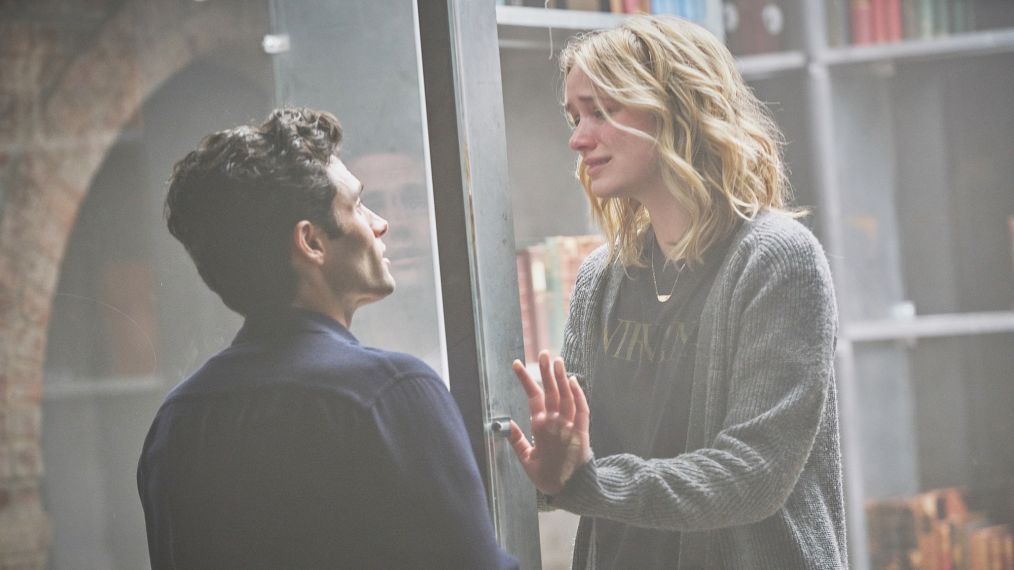
I have watched a lot of things lately that have made me question, what is horror? Most recently, that has been the Netflix original series, YOU. I watched the first season of YOU when it came out on Netflix last year, but I binged the entire first season again in preparation for Season 2, which came out the day after Christmas. What it reminded me was, horror is a complicated genre because it encompasses so many different themes and subgenres. On its surface, YOU has a classic horror premise, a woman finds out that the man responsible for her friends being picked off one by one, is the same man she has been falling in love with. But YOU complicates this premise through tone. Aside from a few brilliant horror sequences, the show is at its core a dramedy and a romance.

The killer in question, Joe Goldberg, is played flawlessly by Penn Badgley, who makes the character sympathetic and charming one minute, and repulsive and insane the next. Joe keeps the audience captive in his own mind through a first person narration, just like he keeps his victims trapped in a glass cage. Season 1 of this show challenges the viewer’s concept of who Joe is by following a scene of Joe being a good mentor to his abusive neighbor’s son Paco with a disgusting reminder of what he is really capable of: masturbating in the street to the sight of Beck through her open window, or plotting to murder another person in Beck’s life who he deems a threat to their relationship.

Image result for you joe and beck

But what YOU does best of all is depict Joe’s girlfriend/obsession/victim Beck as an extremely complex human being, a good person who does bad things, but still does not deserve to die by Joe’s hand. Beck cheats, lies, helps Joe to cheat, and tolerates toxic friends, all which infuriate the audience, and Joe. Yet, when she ends up in the glass prison herself, any sympathy the audience might have held for Joe disappears, because it is frankly sickening. Elizabeth Lail’s performance is captivating and heartbreaking, and the story she writes from within “Bluebeard’s Castle” hits hard for every girl who hoped the perfect romance would make her life complete.

 I loved Beck’s character from her first scene on screen. She’s an MFA creative student, a book lover, and woman struggling with very real problems, like manipulative friends, a difficult family, and creative and monetary pressure academically. Lail is magnetic as Beck, but Joe’s idealized constructed image of her is clearly a fantasy. It is no surprise that he snaps when that fantasy is broken. In Season 1, YOU paints a near perfect picture of what gaslighting, manipulation, and signs that point towards potential violence could look like. Hearing Joe justify his own stalking and murder to himself is both enlightening and despicable. The cautionary tale ends with Beck’s crushing poem, which I will include below, before showing the audience the true extent of Joe’s potential for evil. 

It is for all of these reasons, that I found Season 2 of YOU a little disappointing. As television, it is incredibly well-made and entertaining. However, it does not carry the thematic depth that Season 1 holds. Season 2 bombards you with Joe’s tragic backstory, and his only two kills are desired by the audience. Joe kills a mob-ish man out of self defence, and Henderson, a known child molestor. I was gratified when I thought Joe killed Delilah, proving once and for all that killing was his deepest instinct. However, that death is credited to Love, who is revealed to be a psycho all on her own. Love and Joe are apparently soulmates, bound by their shared murderous tendencies. Their fairytale ending results in them moving in together, about to have a child. Although I must admit, it was a nice touch not to let the audience forget what Joe really is, by hinting that his fixation will shift to a woman sunbathing in their neighboring yard. 

What I love most about this show, is that at least in Season 1, YOU refuses to romanticize Joe’s actions. While the audience might find themselves falling for the “everythingship” or “I wolf you,” the horrors that Joe is capable of are always in the back of your mind. There are no excuses made for his actions, aside from his own denial, and seeing Joe transform from the perfect boyfriend into a vicious killer is chilling. I will admit that Love herself can actually be quite scary, and possibly a perfect match for Joe, but somehow her storyline serves to validate Joe to the audience, rather than the other way around. It says, “see! It’s ok this time! She’s a killer too!”. I do believe that YOU’s intentions are good, and a nuanced audience would look at Love and Joe as a horror show of their own making, but many viewers may not be so mindful. Season 1’s victories lie in how well Joe is depicted as a horrible person, even from within his own mind. 

So I return to my first question, is YOU horror? And I believe the answer has to be...yes. Every time Joe talks about what love is to him, that’s horror. Every time his gaze falls on a new woman, that’s horror. To hear Beck grieve her stolen life from within the cage, that’s horror. And most horrific of all is imagining Love and Joe as parents...enough said. The self contained nature of the Season 1, building dread and tension with precision, creates a stomach dropping feeling of horror when Beck finds the box in Joe’s bathroom ceiling. In that moment, you know with complete certainty that she will die. And despite all of her flaws, I mourned Beck. Because she was a real woman, with so much potential, who Joe dared to kill out of his own twisted, selfish, love.


Saturday, December 14, 2019

Black Christmas (1974)

1974’s Black Christmas is a film that greatly surpassed my expectations. Going into it on Joe Bob Briggs’ “Red Christmas” special, I expected a classic slasher from the time period: annoying characters you kinda hope will die, a classic Final Girl situation, and an outside world oblivious to the killer’s actions. However, it is my view that Black Christmas is thoughtful, relevant, and includes a number of impressive cinematic techniques, as well as a wealth of fascinating discussion points. In a predominantly female cast, I felt that the characters in the film, aside from those used only for comic relief, had a depth to their personality and were experiencing very real issues any college student might find themselves facing.

The very first thing that caught my eye in the film, aside from the killer’s chilling POV shots, was some of the costume choices in the first party scene of the film. Margot Kidder’s character Barb is wearing a black choker that says “YES,” and Olivia Hussey’s Jess is wearing a sweater depicting giant hands that cover her chest. While I doubt that Bob Clark intended for a commentary on consent to be made by the wardrobe in his film, that is where those subtle visuals took me as a viewer. Sexual harassment, and the agency of women to make their own choices, come up several times in Black Christmas. The obscene phone calls from Billy, Jess’ pregnancy, and the house mother’s mockery of Mr. Harrison’s insistence that his daughter is not in college to drink and pick up boys, all speak to important issues of women’s freedom that were relevant in 1974 and are relevant today.

The depictions of Jess’ pregnancy and desire for an abortion are particularly striking in the film. Her boyfriend Peter’s reactions honestly make him a more terrifying villain than the actual killer. While Billy’s bloodlust and obscene phone calls are certainly disturbing, an abusive boyfriend is a much more realistic threat for a woman in college to face. Peter’s violent outburst and vague threats are frankly chilling, and make it clear to the audience that getting an abortion should be Jess’s choice, and her choice alone. Another moment in the film drives this point home is that when Jess has to explain why she is afraid of Peter to Lieutenant Fuller, he does not chastise her for wanting an abortion. Instead, he takes her seriously, makes an effort to stop the obscene phone calls, and tries his best to reach the house before it is too late as Billy begins his final killing spree.

Despite the police believing that Peter was the killer and the case is closed, overall, Fuller responds very seriously to the concerns of the women in the film. Aside from the idiotic Sargent Nash, the women in this film are listened to and believed. As disgusting as Billy’s actions and language are, this film does not feel misogynistic in the way that many early slashers do. The female characters have agency in their world, make their own choices regarding their bodies and sexuality, and the men who try to help them are allowed to live, while the ones who threaten them are not. It’s true that Billy probably kills Jess following the closing credits, in classic slasher fashion, but I will remember Black Christmas as a film that did its female characters justice, even as it picked them off one by one.

Image result for black christmas 1974 title card

Sunday, September 15, 2019

Sharp Objects (2018) & It (2017/2019)

I was about halfway through watching Sharp Objects when the idea for this essay struck me. After realizing Sophia Lillis was playing the young versions of both Camille Preaker and Beverly Marsh, I started to notice similarities in the experiences of their characters; two women traumatized in their childhoods, returning as adults to their small hometowns to face those traumas head on. I initially wanted to write about ‘place’, and the way that a horrific event can linger, or repeat itself, in the place where it happened, focusing on the similarities between Derry and Wind Gap, and the differences between different characters’ responses to the trauma they suffered in those towns. However, after finishing Sharp Objects, and after seeing the second chapter of It, I realized that Derry or Wind Gap could really be anywhere. Evil does not originate from a place, but from within people. Leaving Derry does not do Beverly Marsh any more good than leaving Wind Gap did Camille Preaker. If there is anything these films have in common, it is how they show that violence, trauma, or evil can follow a person anywhere.
Image result for young camille preaker
Lillis as Camille Preaker

Image result for beverly marsh and camille preaker
Lillis as Beverly Marsh

Before I get into it, however, there are a couple of comments I need to make about It: Chapter Two. Firstly, I didn’t particularly like the film. I felt the first It film was drastically more cohesive, and while neither movie was particularly scary, made a much better horror film. Chapter Two, unfortunately, felt more like a sci-fi action comedy with jump-scares. I specifically had serious issues with the film’s tone and how character arcs were handled/not resolved. While I have not read Stephan King’s novel, I am curious to find out how that text differs tonally from its on-screen counterpart. Secondly, and most importantly, I did not feel like this adaption updated some of its content in a way I would have expected to see in 2019. The attack on the gay couple reads differently set in 1984 as it is in the book, than it does set in 2016 in the film--especially considering how horrifically the violence of this scene was portrayed. And while I would not have asked for this scene to be cut entirely, I would have preferred for the film to have redeemed the undercurrent of homophobia in the storyline more successfully. While revealing to the audience that Richie had been in love with Eddie since childhood was an appreciated gesture, it was apparently too subtle for a surprising number of straight audiences to even pick up on. Furthermore, the depth of Richie’s internalized homophobia, as well as the fact that what Pennywise calls his “dirty little secret” is never revealed to the Loser’s Club in any explicit way, makes the film’s attempt to say “Don’t worry! We’re not homophobic!” fall more than a little flat. I could probably go on and on about this for pages, but since sexuality is not the theme in this film I actually wanted to address, I will move on.

The list of similarities between Beverly’s experience and that of Camille in Sharp Objects is pretty astounding. Both women were abused by a parent, and both dealt with that trauma in extremely self-destructive ways. Camille copes through excessive drinking and self harm, while Beverly never truly escapes her past by marrying a man who treats her almost exactly like her father did. When she returns home however, we see where her journey deviates from Camille’s. Most of the Losers have an individual scene where they conquer their demons, and in Beverly’s she finds herself locked in a bathroom stall, much like that from the first film, which fills with blood while her various childhood tormentors try to break in. While I understand how meaningful it is to have her and Ben save each other in this scene, I would have liked to see Beverly combat her past on her own. It is her personal inability to break out of the cycle of violence her father initiated that leads her to end up in an abusive relationship, and rather than simply being saved from it by a ‘good man’, Beverly needed reconcile these issues for herself outside of a romantic context involving Ben. Similarly to the ‘damsel in distress’ plotline of the first film, Beverly is stripped of much of her agency, leaving her dependent on boys who often don’t seem to view her as more than an object of their romantic whims.

To return to Sharp Objects, there is an energy much like ‘It’ that resides in Wind Gap. While it may not manifest literally in the form of a dancing clown, the influence of ‘It’ lives inside many of the residents of Camille’s hometown—a personification of the abject impulses within human beings that drive them to harm one another. For many ‘It’ is passed down like a disease from abuser to victim, forcing its vessels to reenact the trauma they experienced. However, rather than focusing on these traumatic events themselves, Sharp Objects addresses the aftereffects and repercussions of those acts on the people who suffered them, as well as the people who stood by and watched. When Camille returns to her hometown, she has a very literal demon to conquer, rather than an entity like Pennywise. Like Beverly, Camille returns home hiding the physical marks of the pain she has suffered, and it is only through acknowledging and accepting that her mother is responsible for her sister’s death, as well as her own abuse, that Camille is able to move on from her past. While most characters have varying degrees of knowledge of what happened to Camille’s sister Marian, or to Anna and Natalie, no inhabitant of Wind Gap was truly spared. While those directly involved, namely Amma and Camille, find outlets to re-enact the violence that was done to them by their own mother, Camille takes that trauma out on herself, while Amma follows in her mother’s footsteps, killing girls her age, albeit in a much more gruesome fashion that Adora’s rat poison.

While ‘It’ does not literally exist in the world of Sharp Objects, it is clear that similar questions of what makes people do bad things to one another are being asked by both films. Derry and Windgap share a lot of common threads: repeated cycles of violence, missing/dead children, and abusive, unhelpful, and incompetent adults. However, there is one particular difference that I find most fascinating, one defining characteristic that separates the perpetrators of violence in these two towns. The killers in It are men, and the killers in Sharp Objects are women. This distinction creates an interesting parallel between Henry Bowers and Amma Crellin in particular. Bowers was abused by his father, and went on to abuse, and later attempt to kill, members of the Loser’s Club, while Amma was abused by her mother, and went on to kill three of her friends. I find it extremely interesting that both cycles of violence remain within the gender of these two characters. While Bowers is ultimately killed by the Losers, Amma’s true nature is only revealed in the final seconds (as well as a mid-credits scene), as the killer that Wind Gap had been searching for throughout the entirety of the series. While it comes as a shock that Adora was not actually responsible, having Amma exposed as a killer makes the prominent theme of cycles of violence lock into place.

The greatest difference between Bowers and Amma, and Beverly and Camille, is how the two sets respond to the trauma they experienced in their childhoods. Bowers and Amma externalize the violence that was done to them, while Beverly and Camille internalize it. While many of the Losers were victims of abuse, it is as if It saw a violent potential in Bowers that could be exploited, that was not present in other characters. If you cannot resist It, you become It. The same could be said about Amma Crellin. Alternatively, Camille and Beverly were required to conquer their own internal roadblocks of self-loathing in order to free themselves from their painful pasts. If there is any message that both It and Sharp Objects are trying to get across, it is that traumas cannot go unconfronted. You can move away from where something terrible happened, and you can try to forget, but eventually, you have to go home and "kill that f**king clown."